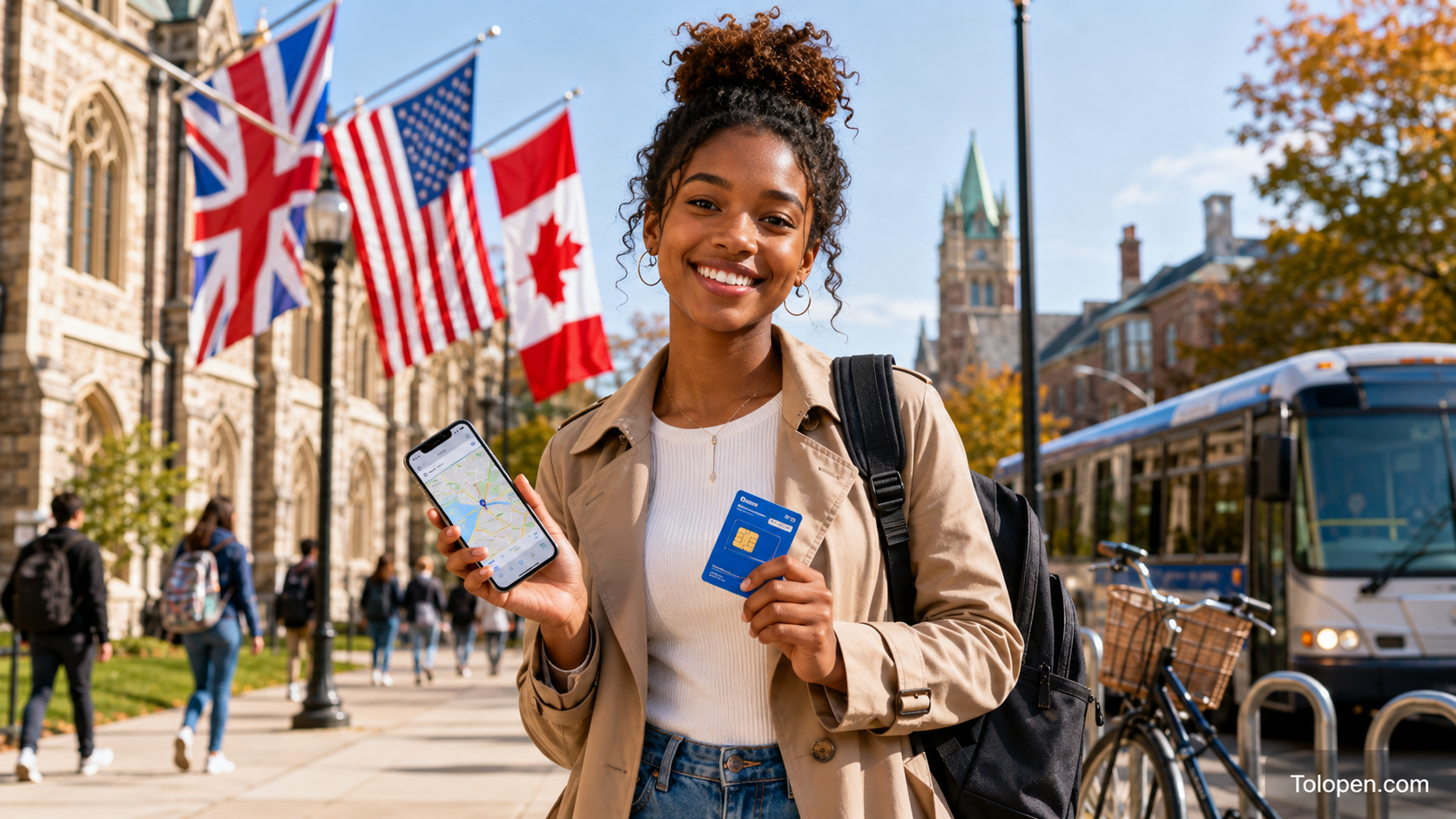
The first few days abroad can feel strangely confusing.
You may have your admission letter, visa, flight ticket, and even accommodation arranged. But once you land, small things suddenly become urgent.
How do you call your family?
How do you open Google Maps without airport Wi-Fi?
Which bus takes you to campus?
Where do you buy a train card?
And why is transportation already taking half of your confidence?
Many international students prepare seriously for tuition, visa interviews, and scholarship applications but forget the everyday survival tools that make life abroad easier. A SIM card, stable internet, and a reliable transport plan may look small, but without them, even simple tasks can become stressful.
This guide explains how international students can get SIM cards, internet, and transportation abroad easily, especially during the first week of arrival.
When you arrive in a new country, connection is not just about scrolling social media.
You need internet to:
Transportation is just as important.
A student who understands the local transport system early will spend less money, avoid unnecessary rideshare costs, and settle into school faster.
The truth is simple: your first week abroad becomes much easier when you can move around and stay connected.
Do not wait until you land before thinking about phone service and transport.
Some mistakes are easier to avoid before your flight.
Before travelling, confirm that your phone can accept SIM cards from other countries.
An unlocked phone allows you to use foreign SIM cards or eSIM plans. A locked phone may only work with your current network provider, which can create problems abroad.
If you are not sure, visit your mobile network provider and ask them clearly:
“Is my phone unlocked for international SIM cards?”
Do this before your travel date. Not at the airport. Not after landing.
An eSIM is a digital SIM that allows you to activate mobile data without inserting a physical SIM card.
This can be helpful for students who want internet immediately after landing.
However, not all phones support eSIM. Some older phones do not. Some country versions of popular phones may also have limited eSIM support.
Before buying any eSIM plan, check your phone settings or manufacturer’s website.
This is one trick many students ignore.
Before travelling, download offline maps of:
Even if your internet misbehaves on arrival, offline maps can still help you find your way.
Save these details before your flight:
Also keep a printed copy in your bag.
Phones can die. Airports can be confusing. Wi-Fi can fail.
Paper still saves people sometimes.
Yes, sometimes.
But not always.
There are three common options:
Buying before arrival gives peace of mind.
Buying after arrival may save money.
The best choice depends on your country, phone type, budget, and how quickly you need internet after landing.
For most students, the smartest approach is this:
Use a short term eSIM or airport SIM for the first few days, then compare local mobile plans after settling in.
Why?
Because airport SIM cards are often more expensive than regular city plans.
You may pay for convenience.
Once you get to campus, ask other students which network is affordable and reliable in that area. A mobile company may be popular nationwide but weak around your university town.
That small difference matters.
A cheap plan is not cheap if the signal is terrible inside your room.
Do not choose a SIM card only because the advert looks attractive.
Check these things first:
As a new student, you will use a lot of data at the beginning.
Maps, WhatsApp calls, university emails, bank apps, accommodation searches, and video calls can consume data quickly.
Choose a plan that gives enough monthly data without punishing overage fees.
Ask students already living near your campus.
A network may work beautifully in the city centre but poorly in student accommodation areas.
Prepaid plans are usually safer for new international students because you are not locked into a long contract.
A contract may look cheaper monthly, but it can become stressful if your visa, study permit, or financial situation changes.
If you call family regularly, check whether the plan includes international minutes.
Many students now use WhatsApp, Telegram, FaceTime, and Zoom, but normal calls may still be needed sometimes.
Some mobile providers offer student deals during university intake periods.
Always ask.
Do not assume the price on the poster is the final price.
Internet access abroad usually comes from three main sources:
Each one plays a different role.
Most universities provide internet access for registered students.
After enrollment, you may receive login details for the school Wi-Fi network. In many countries, universities also use secure academic Wi-Fi systems that students can access on campus.
This is useful for lectures, library work, research, and online assignments.
But campus Wi-Fi will not help you inside a bus, at the airport, or while trying to locate your apartment.
So you still need mobile data.
If you live in university accommodation, internet may already be included in your rent.
If you live in private housing, ask these questions before signing:
Some students only discover after moving in that “Wi-Fi included” means slow internet shared by too many people.
Ask early.
Mobile hotspot can save you when home Wi-Fi fails.
But be careful.
Using hotspot for laptop updates, Netflix, or large downloads can finish your data quickly.
Use hotspot mainly for urgent tasks unless your plan offers generous data.
Internet can quietly eat money if you do not manage it well.
Here are simple ways to reduce costs:
A small monthly saving may not look serious at first.
But over one academic year, it becomes real money.
Public transport abroad can include:
The system depends heavily on the country and city.
For example, London has a strong public transport network, while some smaller towns in the US may require more planning because buses may not run as frequently. In the US, transportation options often depend on whether a student lives in a city, suburb, or smaller college town. (International Student)
This is why students should research transportation before choosing accommodation.
Cheap rent far from campus may become expensive if daily transport costs are high.
During your first week, try to complete these transport-related tasks:
Do not wait until the morning of your first class before learning the route.
That is how students miss lectures, enter wrong buses, or spend unnecessary money on emergency rides.
Many countries offer transport discounts for students, but the rules are different.
In London, eligible students can apply for an 18+ Student Oyster photocard, which gives 30% off adult rate Travelcards and Bus & Tram Pass season tickets. (Transport for London)
In Great Britain, the 16-25 Railcard offers one third off many rail fares and is also available to eligible mature students. (16-25 Railcard)
In the United States, Amtrak offers a student discount for students aged 17 to 24 on eligible train travel booked in advance. (Amtrak)
In Canada, VIA Rail has a dedicated students and youth offers page where young travellers can check available rail deals and promotions. (VIA Rail)
The lesson?
Never pay full price until you have checked whether student discounts exist.
The right app can save you from confusion.
Depending on the country, students commonly use:
For daily movement, Google Maps is usually a good starting point.
But local transport apps are often more accurate for ticket prices, route changes, strikes, delays, and student passes.
Download both.
Transportation can become expensive when students do not plan.
Here are practical ways to save money:
A slightly higher rent near campus may be cheaper than low rent far away with daily transport costs.
Always calculate the full cost, not just rent.
If you travel daily, a monthly pass may be cheaper than paying per ride.
But if you only travel twice a week, pay-as-you-go may be better.
Do the math.
Some universities provide free or low-cost campus buses.
New students often miss this because nobody tells them directly.
Check your student portal or ask the international office.
Uber, Lyft, Bolt, and taxis are useful for emergencies.
But using them every day can destroy your student budget.
Use rideshare when necessary, not as your normal lifestyle.
In some cities, walking is normal and safe.
In others, distance, weather, or safety may make it difficult.
Use common sense. Saving money should not put you at risk.
Many students make the same mistakes every year.
Not because they are careless.
Mostly because they are new.
Airport SIM cards are convenient, but they are not always the cheapest.
Compare plans after arrival before committing long term.
A contract may look attractive until you realize the network is poor in your area or the monthly cost is too high.
Start flexible if you are unsure.
Some students spend months paying full fare because they never asked about student transport cards.
That is painful because the discount was available all along.
This is one of the biggest mistakes.
Before paying rent, check:
Cheap housing becomes expensive when movement is stressful.
Wi-Fi is useful, but you need mobile data too.
Especially during arrival week.
A student without mobile data in a new country is one wrong turn away from serious stress.
Use this simple checklist when you arrive:
That last point matters.
Do a trial journey before your first serious appointment.
It reduces anxiety.
Do not try to figure everything out alone.
When you arrive, speak to:
Students already living there know the real tricks.
They know which mobile network is weak, which bus comes late, which grocery store is cheaper, and which route is safer at night.
That kind of information may not appear clearly on official websites.
Yes. International students can usually buy local SIM cards after arrival, but requirements vary by country. Some countries may request a passport, student ID, proof of address, or visa details before activating a SIM card.
An eSIM can be better for short-term convenience, especially during arrival. A physical local SIM may be better for long-term affordability, depending on the country and provider.
You can, but airport SIM cards may be more expensive. A smart option is to buy a short-term plan first, then compare cheaper student-friendly plans after you settle in.
Many university accommodations include Wi-Fi in the rent. Private accommodation may or may not include internet, so students should confirm before signing any housing agreement.
In many countries, yes. Student discounts may be available for buses, trains, trams, or monthly travel passes. The exact discount depends on the country, city, age, university, and transport provider.
The cheapest option is usually a mix of walking, student transport passes, campus shuttles, bicycles, and public transport. Rideshare apps should be used carefully because daily use can become expensive.
Getting a SIM card, internet, and transportation abroad may not sound as exciting as receiving an admission offer.
But these are the things that make daily life easier.
A connected student can find directions, contact people, attend classes, manage banking apps, and settle faster.
A student who understands transportation can save money, avoid panic, and move around with confidence.
So before you travel, prepare beyond your visa and suitcase.
Check your phone.
Research transport.
Download maps.
Ask about student discounts.
Because sometimes, the difference between a stressful first week abroad and a smooth one is not money.
It is preparation.